Monday, November 8, 2010

WORD & IMAGE

Brian Fries, author and comic book artist, wrote and drew the book "Mom's Cancer", his and his family's experience dealing with his mother's cancer. The University of California, Davis had the privilege to have Mr. Fries come to the Design 001 class and give a lecture on his book, his experience with his mother and with main points to how he became to be, a comic book writer. The picture above gives an example of "Mom's Cancer", portraying Brian Fries' mother in agony. Although the picture could speak for itself, Fries decided to include words, explaining most of the items that are found next to his mother.
Word and image come together in this picture, where the image shows the agony that the mother is going through and we, as an audience, perceive with our eyes the atmosphere and the items that are found close to his mother. The words that link with the image are extremely helpful, not only to know what he images are but to know the meaning behind such objects. Fries knew that the image was not the only thing that would hook his readers but that he would need to draw them in more by explaining such things like the medicine that his mother was taking. Telling his readers these details about the image evoke emotions towards his mother and him for the hardships of cancer. Altogether, Brian Fries makes sure that image and word come together
in his comic book to express in detail what this journey of a cancer battle, provoking his readers to take part of his experience and to visually take a glimpse in what might be a life burden.

dG

Sunday, October 31, 2010

Interaction of Content & Form in OBJECTIFIED


On Friday, the movie, "Objectified" was shown in Design 001. Although we didn't get to finish the movie, this movie is simply mind blowing from the concepts that are shared in the movie to the different designs that are emphasized. Main topics that were shown in the movie include the focus in content and form within every day designs. There is a instant connection between content and form in the beginning with the example of the toothpick.Seeing the toothpick, I was confused as to why a toothpick was being analyzed and why would this be important. The content was the story behind the toothpick: Japan has toothpicks with special top tips in which the tip can be broken from the toothpick, indicating that the toothpick has been used and the tip can serve as a rest for the toothpick (picture shown) The toothpick, being the form of the content, is shown to be an everyday essential but no one seems to pay attention to its design. A toothpick is designed to help people with food in their teeth but no one really takes the time to see the real design of a simple toothpick. A toothpick's design is the following: a piece of wood, sometimes bamboo, sculpted to be short and thin with pointy tips to meet the necessity of people when picking their teeth. The simple design is very attractive to consumers for many reasons, such as the simplicity of the product.
Content and form are connected in design, shown in "Objectified", being that they have a story to share with the people that consume the product or design. Henry Ford once stated, "Every object tells a story, if you know how to read it.", and I believe strongly with this quote because if one does not know the story or content of one design or form then there is not story to tell.


dG

Wednesday, October 20, 2010

Garbage Design?


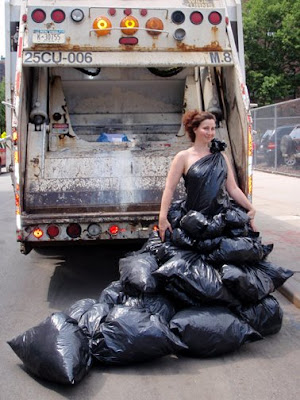
About a week and a half ago, Shine, a website run by Yahoo, came out with an article based on fashion design inspired by the states in the United States. The dress designs include the following: Minnesota had a corn dress, New York had a trash dress, Iowa's dress was based on the prairie, Nevada's dress was made of casino chips, Maine had a pine cone dress, and the list goes on. From the examples that were mentioned above, I was really attracted to the garbage dress inspired by New York and the garbage collection that occurs within the state.
The garbage dress was made out of a large amount of garbage bags that were used to compliment the model. The dress' form was created to be a side shoulder dress with a large skirt, where trash bags were tied to create volume and were puffed up (hopefully not with garbage) from smallest to largest. This is a design that definitely defines New York, trash all around and fashion overall. Looking at this dress, I find it to be quite appealing due to the great use of volume created by the garbage bags and the form all together seem to appeal my eye (even though this is circulated around garbage) . There is a balance that is made with the trash bags because the bags increase from the model's stomach area to the bottom of the skirt. As a society, we are ones that judge fashion and our nation as a whole but this dress to me creates a true vision of New York. New York is famous for fashion and being the "big apple", bringing society's view of fashion together into a design; something that is out of the box, simply unique and couture. Society simply accepts this design of a New York garbage dress.

dG

http://shine.yahoo.com/channel/beauty/artist-creates-themed-dress-sculptures-in-all-50-states-2400848/#photoViewer=1

Monday, October 18, 2010

A Trained Eye

When looking for a new appliance such as a cellphone, television, coffeemaker, what is the first thing that you think about? Is it the price of the appliance, the features that the appliance is capable of doing? No. The first thing that you are attracted to is the design of the appliance. Before even purchasing an item or going out to look for one, there is an immediate moment in which ones brain starts to put ideas together about how the appliance should look and what one is looking for. When going to the store, that is when it gets exciting for a consumer; aisles and aisle full with appliances and very interesting designs. The design that usually wins is the one that is appealing to the human eye and of course, ends up being the most expensive.
This manufacturing industry know how to play the game with its consumers and buyers. They know that the human eye is seduced by different colors and a design that is none like the others, one that is completely spontaneous and is considered to be "rare". A consumer is aware that when they are shopping, they must look for an appliance that will last a long time and have many functions but at the same time looks presentable and in the end, the design beats the features and the durability.

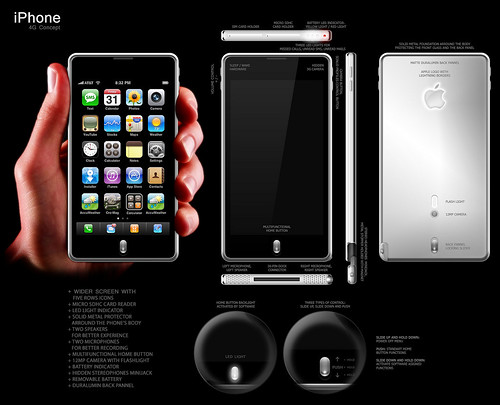
Society makes sure to manipulate society into focusing on the design of the product. One example of this includes the commercial above for an Apple iPhone 4th Generation. After looking at this commercial for a couple of times there is one thing that you notice, the design is emphasized for the most part. The beginning opens showing the design of the iPhone closely and then moves forward into showing a couple of features within the actual product but in the end, there is a list of some features that the phone has but they move to fast. This was done on purpose. The creator of this commercial did not want the features to be the main part of the commercial but it was the design that was the most important for the creator of the commercial to focus on. Simply, design prevails in society and most importantly, with consumers.

dG

Sunday, October 17, 2010

Comparison & Contrast


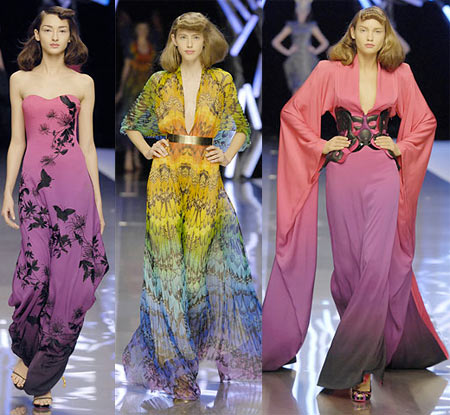
Fashion, every girl's dream. Michael Kors (left) and Alexander McQueen (right) are great examples of fashion that leave the runway and the audience, speechless. Both of these fashion designers have used their creative minds to create these pieces above that seem to have some similarities but also their comparisons. Michael Kors seems like the fashion designer that plays by the fashion rule book, keeping his pieces classy, still fashion oriented and what is in season. Alexander McQueen, on the other hand, experiments with his designs with colors, different fabric designs and goes forth to bring fantasy designs to real life. Both designers have different views in fashion, Michael Kors being a bit more conservative than Alexander McQueen and Alexander McQueen brings more of a wild side to his designs.
Although they might be different with their styles and their designs, Alexander McQueen and Michael Kors share many characteristics that may seem obvious but they are important in the fashion industry. They both have large collections for each season and they are able to have models strutting the runway with their designs. Another similarity that they have is that they are both designers that focus on what is in style during that season to add to their collection. Referring to the picture above, Michael Kors knew that during this season, purple, yellow, and lime green were colors that were a huge hit and that would bring more liveliness to his designs. For Alexander McQueen, he did not stay behind focusing his designs on extravagant uses of color and flowy dresses that would just swoosh back when the models were walking. Both designers are conscious of the designing world because with their designs, they communicate a part of who they are in terms of their taste and their personality, making it evident to the fashion audience that their tastes and them as people are different yet similar.

dG

Saturday, October 16, 2010

Design as a Conversation


Indeed, the sun is down. Above is a clip of Yoko Ono and Lady GaGa combining their talents of singing and creating what you see above. When I first listened to this video clip, I was in design class. I was quite confused in the beginning to why we were listening to this and how it tied into design. Mr. Housefield, my design teacher, later explain a main quality that this clip signified and that is crucial to design in general, communication. Communication is normally seen either verbally or written but not typically associated with visual images transferring information from one to another. Design needs communication to maintain a conversation with the intended audience based on the design presented, conveying the designers view of the world, of a specific topic etc.
Being a source of communication, design is such a broad topic to start a conversation with. Design can be a great source of conversation such as using the example above. One might start to talk about the design of Lady GaGa's extravagant clothing, or the design of the lyrics that are being used to converse between Lady GaGa and Yoko Ono. Conversation dealing with the design of many things is simple, starting with simply looking and analyzing at the design of an object. Questions that can run through people's minds looking at a design might be "What is this used for?", "What was the designer thinking when he was creating this design?" or "What does this design stand for?" Design is a simple way to convey what one is thinking or what one believes, commencing the conversation between a designer's audience. Having a visual design, it makes a conversation easy to have because one's opinion can be backed up with parts of the design, the color, the shape, the images that are being portrayed, etc. Design is a conversation between a designer and the world, commencing the conversation with the design.

dG

Monday, October 11, 2010

Kseniya Simonova, art animator

Kseniya Simonova is a name to know. I first saw this video when my Studio Art teacher, Mr. Barak Smith, showed me this incredible talent that was first seen on the show "Ukraine's Got Talent". Kseniya holds a talent that has not been seen and is quite rare. She has the ability to make sand animation, art that is created with the medium of sand using only sand and her fingers as tools to handle the sand. Her art is not one that can be preserved but the time that the art lasts, it is really miraculous. In the clip above, she is demonstrating her talent through a story line, something that is really creative, giving the art more meaning. The whole concept of this being an animation seems so surreal to me and to many people in the audience as well, especially in minute 5:22 when a woman is being taped to be crying.
Emotions are moved thanks to Kseniya not only because of her talent but with the story that she is telling based on World War II, an event in which many people lived through. To me, this is a great example of design, one that is not permanent but that definitely includes many elements of design; emotion, creativity, planning etc. The design of the sand was definitely played with by her fingers by making different shapes and moving on with the story along with the music that was playing in the background. The designs that she was making were more incredible because she did not have prior experience before coming to the show, and started with sand just as a hobby. The designs that she make convey a story of the past and animate it, coming to life and giving the audience a vivid action of what occurred during those times. My gratitude to Mr. Barak Smith for showing me this video and of course, to Kseniya Simonova for her art animation.

dG